
The Manaslu Larke Pass Trek is one of Nepal’s most rewarding high-altitude trekking adventures, combining dramatic Himalayan landscapes, remote mountain villages, rich Tibetan Buddhist culture, and the challenging crossing of Larkya La Pass. Reaching approximately 5,106 meters (16,752 feet), Larkya La is the highest point of the classic Manaslu Circuit and the defining challenge of the journey.
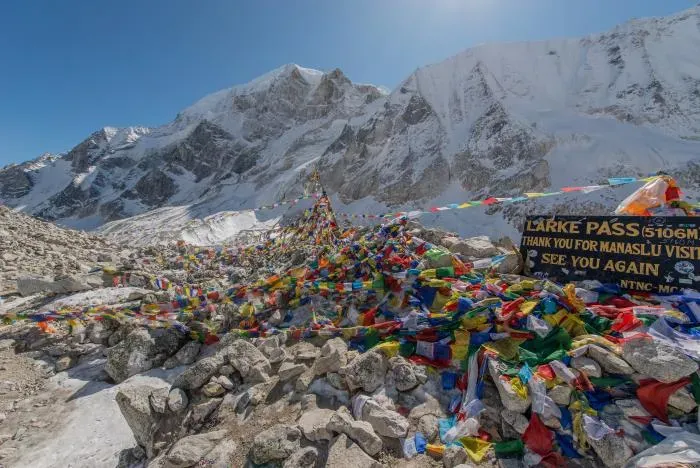
The trek circles Mount Manaslu (8,163 meters), the world’s eighth-highest mountain, while following the Budhi Gandaki Valley from its lower foothills toward the high Himalayas. Along the route, trekkers experience everything from subtropical forests and rushing rivers to glacial landscapes, high mountain passes, monasteries, and traditional Himalayan settlements.
Unlike Nepal’s more established trekking routes, the Manaslu region retains a remote character. The area is regulated as a restricted trekking region, which helps preserve its natural and cultural environment. A typical Manaslu Larke Pass Trek takes around 14–18 days, depending on the itinerary, acclimatization days, transportation, and optional side trips.
What Makes the Manaslu Larke Pass Trek Special?
The Manaslu Larke Pass Trek offers a combination of experiences that is difficult to find on a single Himalayan route.
First, the trek passes through the spectacular Manaslu Conservation Area, where the landscape changes dramatically as you gain altitude. Lower sections feature lush vegetation, waterfalls, suspension bridges, and terraced farmland, while higher elevations reveal pine forests, alpine meadows, glaciers, and snow-covered peaks.
Second, the route provides an opportunity to experience the culture of communities influenced strongly by Tibetan Buddhism. Villages such as Namrung, Lho, Samagaon, and Samdo feature mani walls, prayer flags, monasteries, traditional houses, and mountain lifestyles that have developed over generations.
Finally, the crossing of Larkya La provides the trek’s major adventure objective. The pass involves a long and demanding day at high altitude, but the surrounding Himalayan scenery makes the effort particularly memorable.
Manaslu Larke Pass Trek at a Glance
-
Region: Manaslu, north-central Nepal
-
Highest point: Larkya La Pass, approximately 5,106 m
-
Mount Manaslu: 8,163 m
-
Typical duration: 14–18 days
-
Trek grade: Challenging to strenuous
-
Starting point: Soti Khola or Machha Khola
-
Ending point: Dharapani, followed by road transportation
-
Accommodation: Teahouses and mountain lodges
-
Best seasons: Spring and autumn
-
Major attraction: Larkya La Pass crossing
-
Permits: Restricted Area Permit and conservation-area permits
-
Guide: A licensed guide is generally required for the restricted Manaslu area.
Manaslu Larke Pass Trek Route
The journey usually begins with a scenic but lengthy drive from Kathmandu toward the trailhead. Depending on road conditions and the selected itinerary, trekkers may start around Soti Khola or Machha Khola.
From the lower Budhi Gandaki Valley, the trail gradually climbs through villages such as Jagat, Deng, Namrung, and Lho before reaching Samagaon. This gradual progression is important because it allows the body time to adjust to increasing altitude.
A common route follows this general pattern:
Kathmandu → Machha Khola → Jagat → Deng → Namrung → Lho → Samagaon → Samdo → Dharamsala → Larkya La Pass → Bimthang → Dharapani
From Dharapani, trekkers can connect with the Annapurna region and continue by road toward Besisahar and Kathmandu. Route lengths vary according to the exact starting point and itinerary, with published estimates commonly placing the complete trekking distance around 150–180 km.
Detailed Trekking Experience
Kathmandu to Machha Khola
The adventure starts with a drive from Kathmandu toward the Manaslu region. The road journey is long and can be rough in sections, but it gradually takes you away from Nepal’s busy urban environment and toward rural mountain landscapes.
Machha Khola serves as one of the popular starting points for the trek.
Machha Khola to Jagat
The trail follows the Budhi Gandaki River, passing through forests, waterfalls, suspension bridges, and small settlements. The route is relatively lower in altitude but can still be physically demanding because of repeated ascents and descents.
Jagat to Deng
As the trek continues, the valley becomes narrower and more dramatic. You pass through villages and forested sections while gradually gaining altitude.
Deng is an important overnight stop before the trail begins climbing more noticeably toward the higher Himalayan villages.
Deng to Namrung
The scenery changes as you approach Namrung. The surrounding mountains become more prominent, and Tibetan cultural influences become increasingly visible.
Namrung, located at around 2,600 meters, is an important stage of the trek because altitude gain becomes more significant from this point onward.
Namrung to Lho and Samagaon
This is one of the most spectacular sections of the Manaslu Larke Pass Trek. The trail passes through alpine landscapes and traditional villages while offering increasingly impressive views of Manaslu and surrounding peaks.
Lho is particularly notable for its Buddhist monastery and mountain views. From Lho, the trail continues toward Samagaon, one of the most important settlements on the Manaslu Circuit.
Acclimatization at Samagaon
Samagaon is commonly used for acclimatization before moving toward the higher elevations. Rather than simply resting inside the teahouse, trekkers can take a short acclimatization hike around the surrounding area.
Possible excursions include viewpoints and nearby glacial landscapes, depending on the group’s itinerary, weather, and physical condition.
Acclimatization is one of the most important parts of the Manaslu Larke Pass Trek because the route eventually reaches more than 5,000 meters. A well-planned itinerary should avoid gaining altitude too quickly.
Samagaon to Samdo
From Samagaon, the trail continues toward Samdo, another traditional high-altitude settlement. The landscape becomes increasingly barren and mountainous as trees gradually disappear.
Samdo is located close to the Tibetan border region and reflects strong Tibetan cultural influences. The surrounding mountains and open alpine terrain provide a striking contrast to the green valleys encountered earlier in the trek.
Samdo to Dharamsala
The route then climbs toward Dharamsala, also known as Larkya La Phedi. At approximately 4,460 meters, this is the final major overnight stop before the pass.
Accommodation here is generally basic, and conditions can be cold, particularly outside the main trekking seasons. Because the next day involves crossing Larkya La, trekkers should prepare their clothing, water, snacks, headlamp, trekking poles, and other essential equipment the night before.
Crossing Larkya La Pass
The Larkya La Pass crossing is the highlight and most demanding section of the Manaslu Larke Pass Trek.
The pass reaches approximately 5,106 meters, although some sources give slightly different figures depending on measurement methods.
Trekkers normally start very early from Dharamsala. The climb takes place in cold conditions and may involve snow, ice, rocky terrain, or moraine depending on the season.
There is no substitute for proper preparation on this day. The combination of high altitude, cold temperatures, strong winds, and a long walking distance makes the crossing physically demanding.
At the summit, trekkers are rewarded with panoramic Himalayan scenery and the satisfaction of reaching the highest point of the entire route.
After crossing the pass, the trail descends toward Bimthang. The descent can be particularly tiring because of loose terrain and the substantial elevation loss during the day. Some itineraries describe the pass-crossing day as roughly 8–10 hours of trekking, though individual times vary considerably.
Bimthang and the Descent to Dharapani
After the demanding Larkya La crossing, Bimthang provides a welcome change of scenery and a chance to recover.
The trail gradually descends through forests and alpine landscapes toward lower elevations. Rhododendron, pine, and other vegetation return as the altitude decreases.
Eventually, the route reaches Dharapani, where the Manaslu Circuit connects with the wider Annapurna trekking area.
From here, trekkers normally use road transportation to continue toward Besisahar and Kathmandu.
Manaslu Larke Pass Trek Difficulty
The Manaslu Larke Pass Trek is considered challenging to strenuous, primarily because of its altitude, long trekking days, changing terrain, and the Larkya La crossing.
You do not need technical mountaineering skills for the standard route, but good physical preparation is important.
Before the trek, it is useful to build endurance through:
-
Long-distance walking
-
Uphill hiking
-
Stair climbing
-
Cardiovascular training
-
Strength exercises for the legs and core
-
Regular hikes carrying a moderate backpack
The goal is not simply to walk fast. A steady pace and proper acclimatization are much more important at high altitude.
Altitude and Safety
Altitude is one of the most important considerations on this trek. Once the route rises above 3,000 meters, trekkers should pay close attention to how their bodies respond.
Common symptoms of altitude sickness can include headache, dizziness, nausea, fatigue, and difficulty sleeping. Severe symptoms require immediate attention and may necessitate descending to a lower elevation.
For safety:
-
Follow a gradual itinerary.
-
Stay properly hydrated.
-
Avoid rushing at high altitude.
-
Inform your guide about unusual symptoms.
-
Keep warm during cold mornings and nights.
-
Follow the group’s acclimatization plan.
-
Be prepared to descend if serious altitude symptoms develop.
Weather conditions can also change rapidly around Larkya La, so flexibility is important.
Permits for the Manaslu Larke Pass Trek
Because the Manaslu region is a restricted trekking area, special permits are required. The commonly required permits include the Manaslu Restricted Area Permit (RAP) and Manaslu Conservation Area Permit (MCAP). Once the route enters the Annapurna Conservation Area around the western section, an Annapurna Conservation Area Permit (ACAP) is also generally required.
Permit regulations and fees can change, so trekkers should confirm the current requirements with a registered trekking agency or the relevant Nepal authorities before departure.
Best Time for Manaslu Larke Pass Trek
The most popular trekking seasons are spring and autumn.
Spring: March to May
Spring brings relatively favorable trekking conditions, blooming rhododendrons at lower elevations, and generally good mountain visibility. As the season progresses, conditions around the high pass can become more favorable.
Autumn: September to November
Autumn is another popular period because the monsoon generally leaves clearer skies and fresh mountain scenery. October and November are particularly popular for Himalayan trekking.
Winter can bring significant snow and cold at higher elevations, while the summer monsoon can create wet trails, clouds, landslides, and transportation difficulties.
Accommodation and Food
The Manaslu Larke Pass Trek is primarily a teahouse-based journey. Accommodation becomes increasingly basic as you travel toward the high-altitude sections.
Rooms commonly feature simple beds and shared facilities. At higher elevations, amenities can be limited, so trekkers should maintain realistic expectations.
Dal bhat, noodles, rice, soups, potatoes, pasta, eggs, Tibetan-style foods, tea, and other basic meals are commonly available along established sections of the route.
Carrying energy snacks such as nuts, chocolate, dried fruit, and energy bars can also be useful during long trekking days.
Essential Packing List
A suitable packing list should include:
-
Waterproof trekking boots
-
Warm down or insulated jacket
-
Thermal base layers
-
Fleece layer
-
Waterproof jacket and trousers
-
Warm gloves and hat
-
Sunglasses and sunscreen
-
Sleeping bag suitable for cold conditions
-
Trekking poles
-
Headlamp and spare batteries
-
Water bottles or hydration system
-
Personal first-aid supplies
-
High-energy snacks
-
Basic toiletries
-
Backpack and rain protection
-
Microspikes or other traction equipment when conditions require them
Your exact equipment should be adjusted according to the season and current trail conditions.
Why Choose the Manaslu Larke Pass Trek?
The Manaslu Larke Pass Trek is particularly appealing to trekkers who want more than spectacular mountain scenery. It combines physical adventure with cultural exploration.
You can walk through traditional Himalayan settlements, observe Buddhist traditions, cross suspension bridges over powerful rivers, experience the dramatic transition from green valleys to alpine terrain, and finally stand on one of Nepal’s most famous high mountain passes.
The journey also offers a strong sense of progression. The landscape changes almost every few days, making the trek feel like a continuous adventure rather than a single destination-focused hike.
Conclusion
The Manaslu Larke Pass Trek is a demanding but deeply rewarding Himalayan journey. From the river valleys and forest trails of the lower Manaslu region to the Tibetan-influenced villages of Samagaon and Samdo, every stage introduces a different side of Nepal.
The ultimate challenge is the crossing of Larkya La Pass at approximately 5,106 meters, where altitude, weather, terrain, and endurance come together. With proper acclimatization, physical preparation, suitable equipment, experienced guidance, and a carefully planned itinerary, trekkers can experience one of Nepal’s most memorable high-altitude routes.
For travelers seeking dramatic Himalayan scenery, authentic mountain culture, remote trails, and a challenging pass crossing, the Manaslu Larke Pass Trek offers an exceptional trekking experience in Nepal.
